Nowhere to Be Until the Next Stop: The Quiet Pleasure of a Pointless Train Journey
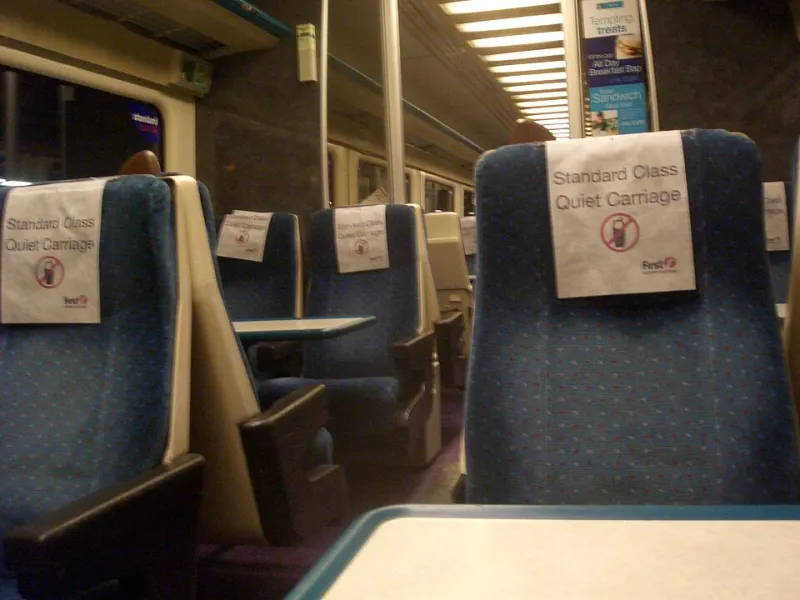
Photo: No machine-readable author provided. Edward assumed (based on copyright claims)., Public domain, via Wikimedia Commons
There is a particular kind of relief in being between stations. Not at home, where the dishes are looking at you. Not at work, where your inbox has opinions. Not even at your destination, where someone might ask what you are doing with your afternoon. Just on a train, moving, with no useful task available except to sit there and let the country go past.
That may sound like a small thing. It is a small thing. But small things are often what we have, and a short train journey is one of the few socially acceptable pauses left in a busy week. Nobody rings you to ask why you are on the 11:42 to somewhere modest. Nobody expects you to produce a deliverable between two stops on a branch line. You have a ticket. You have a seat, if you are lucky. For twenty or forty minutes, your only job is to remain attached to the earth while it moves.
The quiet carriage is not a library, but it is close
The quiet coach has its own etiquette, and it is mostly about not making your business everyone else’s. Phone calls are out. Music is fine, as long as it stays in your headphones and not in the air around your neighbour’s left ear. Crisps can be eaten, though perhaps not with the slow, deliberate crunch of someone trying to summon a demon. If you have a conversation, keep it low and short. If someone forgets, a polite glance usually does more than a speech.
What I like about the quiet carriage is not the silence itself. It rarely is silent. There is the soft clatter of the track, the occasional sigh of the doors, a bag being zipped, someone turning a page. It is a low-level soundscape, the kind that asks nothing of you. You can hear that other people are there without being required to engage with them. In a world that treats every spare minute as an opportunity to optimise, that feels almost radical.
It also helps that the rules are already written. You do not have to explain yourself. You do not have to be charming. You can put your head against the window, watch a wet field slide by, and let your face do whatever it wants. If you are tired, you look tired. That is allowed on a train. It is practically the national dress.
The comfort of being moved
There is a reason people fall asleep on trains. The motion is steady, the sound is dull and rhythmic, and you are temporarily released from the responsibility of steering. You are a passenger in the most literal sense. The track has the plan. The driver has the route. Your role is to be carried.
For anyone whose brain runs hot with lists, that handover can be a relief. You cannot tidy the carriage. You cannot answer the email that has been sitting there since Tuesday. You cannot start a home improvement project in the vestibule. You can only look out at the backs of houses, the allotments, the retail parks, the sudden wide fields that appear between towns as if someone forgot to build there. The view is not always beautiful. It is better than beautiful sometimes. It is ordinary, and ordinary is restful.
I have come to think of a short train ride as a kind of horizontal meditation with better snacks. Not a cure for anything. Not a replacement for support if you are struggling. Just a pocket of time with edges around it. It starts when the doors close. It ends when you stand up. In between, the day cannot quite get at you in the usual way.
Plan something small, cheap, and slightly pointless
The trick is not to turn this into a project. You are not training for the Orient Express. You are looking for a short, low-cost loop that gives you an hour or two of gentle motion and a reason to leave the house without asking too much of yourself.
Start with your local station. Look for an off-peak return to a town one or two stops away. Somewhere with a platform, a café if you want one, and no obligation to do anything once you arrive. A branch line is ideal. A busier route works too, as long as you can find a quiet coach and a window seat. If you have a Railcard, use it. If you do not, an off-peak day return is usually cheaper than a cinema ticket and comes with a better view than most screens.
Pack light. A flask, a snack, a jumper, headphones. Nothing that turns the journey into homework. No laptop. No self-improvement audiobook unless it is genuinely comforting. The point is to be under-stimulated in a pleasant way. If you get to the other end and only manage a walk around the block before getting the train back, that counts. The journey is the outing.
The return leg counts too
There is a lovely flatness to the journey home. The day has already happened, or not happened, and the train is carrying you back to it. You might feel a little softer than when you left. You might feel nothing at all. Both are fine. The point was never to force a transformation. It was to give yourself a place where you did not have to perform being okay, or productive, or even particularly interesting.
On the way back, notice the small sounds. The ticket inspector’s zip. The announcement that the next stop is yours. The particular hush that falls when a train pulls into a station and everyone briefly considers getting off. You do not have to do anything with it. You can just let it be the soundtrack to a few minutes of not being needed.
We are told constantly to use time well. A short train ride is a gentle disagreement with that. It is time used softly. You are not going anywhere important. You are just going. For a while, that is enough.